Posts

HERITAGE LINCOLNSHIRE OPEN DAYS 2015

Image
EMESS are taking part in Heritage Lincolnshire Open days on: Thursday 10th and Friday 11th September 2015 Between: 10am to 4pm At: The Barn(High House Barn), Tumby Moorside, Coningsby, Lincolnshire, PE22 7ST -------------------THIS EVENT IS FREE!!---------------------- Experience Mud and Stud - almost unique to Lincolnshire. See renovation work to this Rare 18th century Mud and Stud Barn by EMESS. Plus exhibition of photographs and information on Mud and Studs in Lincolnshire. Rodney Cousins and David Glew will be leading these days. All members and non-members are welcome! In other news, The Cabin finally has a new owner, and the property is no longer on the market.

URGENT! 'THE CABIN' NEED A NEW OWNER!

Image
 'THE CABIN' is a 17th Century Grade II listed mud and stud cottage in Thimbleby, Lincolnshire. It is looking for a caring owner, who understands the needs of mud and stud cottages. It is a double bedroomed home, inclusive of a vaulted reception room with a mezzanine, kitchen, bathroom and off road parking with attractive gardens laid to lawn. Could this home be for you?  Guide Price is £159,950 but is negotiable. You can find this property on rightmove and 'on the market' with JH Walter, Lincoln below! http://www.rightmove.co.uk/property-for-sale/property-48668173.html https://www.onthemarket.com/details/1238111/

NEXT EMESS MEETING

The next EMESS Meeting will take place in June (date to be agreed), where a walkabout in the village of Moorby was proposed by Rodney Cousins. Following that, during the National Heritage Open Days, the Barn at Tumby will be on display on Thursday 10th and Friday 11th september 2015, when Rodney Cousins and David Glew will be in attendance. Other members are welcome.

RECENT EMESS MEETING

Image
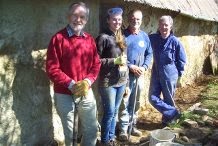
EMESS held its  most recent meeting on Saturday the 4th April 2015 at the barn at Tumby Moorside, Lincolnshire. This is a Grade II listed building which the society is gradually repairing, by carrying out the work on a like for like basis. Those who attended were: Rodney Cousins, Trevor Oliver, Eleanor Harris, Tony Bonham and David Glew. The work carried out this time including mixing and applying mud repairs to the original mud and stud walling, to maintain it's structural integrity. In addition the base of a length of the south wall was stabilised by laying salvaged bricks in mud mortar, to continue repairs which were started a few years ago. The French drain along the south wall was also repaired, by excavating and sieving gravel, and putting it back inside the line of bricks, to reduce the volume of rising damp within the walls. Finally, limewash was applied to previous mud repairs on the north and south walls, to help protect the walls in the future. During a short busin...

FILM REVIEWS

The 1956 film “The Ten Commandments”starred Charlton Heston as Moses from the Bible. At one time, as a Jewish slave in Egypt, he was shown building with mud. This was a very Hollywood version of such work, as what was shown was the use of a very wet, sloppy mix, and so the conditions portrayed were very messy. Such a mix could have been used for mud mortar, but not for the mud bricks which were the subject of the work in hand. The mix for bricks needs to be wet enough to be malleable, but not so wet that its splashes about. The mix for mortar does need to be wetter, however, in order for it to fit around the bricks to make a homogeneous whole. The 2005 film “The New World” starred Christian Bale as Captain John Smith who married Princess Pocahontas on the east coast of the USA when Europeans first settled in that country. Once the village was established, there are scenes in the film showing the cottages in which people lived, which look like correct portrayal...

MORE HISTORIC EARTHEN BUILDINGS in USA

In the last episode of the Ray Mears series “How the Wild West was Won” on BBC 4, he featured the homes of the Navajo Indians in the Sanoran Desert in the south-west of the USA. Their houses were called hogoms, and they consisted of earth piled up on a pyramid-like timber frame to provide one large simple volume. Because of the heat, the earth became baked hard and dry. However, there was also occasional torrential rain and if any earth was washed off, it could be repaired using the material which was all around – more earth. The timber itself was a scarce resource, and so it was re-used if homes had to be re-built. Again the structures were warm in the winter but cool in the summer.

2014. MEETING 1 : THIRD ANNUAL LECTURE

At the University of Lincoln on 26 February 2014 Attended by students of architecture, guests, members of Greenpeace and the Abundant Earth Community, and EMESS members. On behalf of the School of Architecture, Marcin Kolakowski welcomed everyone.  He mentioned that 15 student projects were on the subject of sustainable architecture - but what was this subject really ?  It was not about CO2 emissions or U-values, but about low technology and going more widely and more slowly, rather than narrowly and quickly.  There is a crisis of meaning, of consumerism, etc in modern times. The Abundant Earth Community is trying to improve physical, mental and economic health.  They are an intentional community which might take the form of a workers' co-operative or a housing co-operative.  In practice they would work off the grid to produce food through many collaborators, and they have become a client figure for an architecture project.  See ...